English
 Türkçe

24/7 Call Center

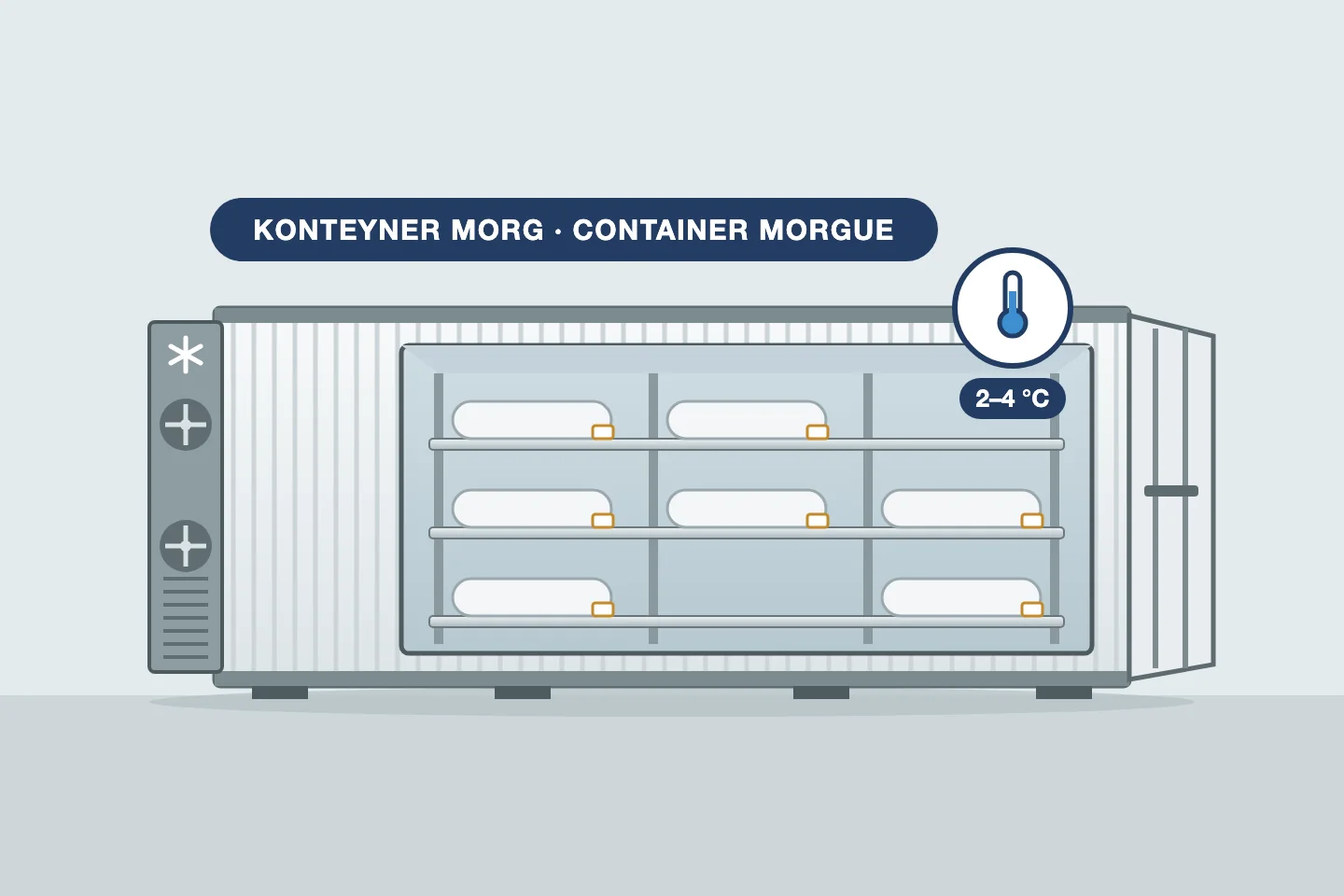
A container morgue is a temporary body store set up by fitting racks or trays inside a refrigerated container. When an earthquake, flood or epidemic causes many deaths at once, permanent mortuaries may not have enough capacity. This article summarises the temporary storage options described in the field manual for first responders prepared jointly by the Pan American Health Organization (PAHO), the World Health Organization, the International Committee of the Red Cross and the International Federation of Red Cross and Red Crescent Societies. We approach the subject with respect for the dead and for families' right to identification.
Why temporary storage is needed
According to the manual, decomposition advances rapidly without cold storage; in hot climates it can be too advanced for facial recognition within 12 to 48 hours. Cold storage slows decomposition and preserves the body for identification. Permanent mortuaries cannot be built for every exceptional scenario: HBN 16-01, the hospital mortuary design guidance used in England, also says that additional permanent storage for exceptional excess deaths is not economically feasible, and recommends planning space for temporary body stores in or near the mortuary.
How a container morgue is used
The manual describes refrigeration as the best option:
- Temperature: refrigeration between 2 °C and 4 °C is the best option.
- Capacity: refrigerated transport containers used by commercial shipping companies can store up to 50 bodies.
- Availability: enough containers are seldom available at a disaster site, so other storage methods should be used until refrigeration arrives.
Whatever the method, each body or body part is placed in a body bag or wrapped in a sheet before storage, with a waterproof label carrying a unique number (for example, paper sealed in plastic). Numbers are not written on bodies or bags, because they are easily erased during storage.
Options when no container is available
Dry ice: the manual says it may be suitable for short-term storage. Dry ice is not placed on top of bodies, even when wrapped, because it damages them. A low wall of dry ice about 0.5 m high is built around groups of about 20 bodies and covered with a plastic sheet, tarpaulin or tent. About 10 kg of dry ice per body per day is needed, depending on outside temperature. Dry ice causes cold burns if touched without gloves, and the carbon dioxide released as it melts is toxic, so well-ventilated areas are preferred to closed rooms.
Temporary burial: an option where no other method is available or longer temporary storage is needed. The manual recommends a depth of 1.5 m, at least 200 m from drinking water sources, 0.4 m between bodies and a single layer. Each body is clearly marked and its position marked at ground level so that it can later be recovered and returned to the family.
Ice: should be avoided where possible. It melts quickly in hot climates, produces large amounts of dirty waste water and may damage bodies and personal belongings such as identity cards.
What facilities should plan in advance
HBN 16-01 asks for capacity measures to be planned beforehand: agreements with a local network of public and private mortuaries, cooperation with funeral directors, buying or renting temporary flat-pack fridges, and a cold room that can serve as an ordinary store when not needed for bodies. A level site for the container, a continuous power supply, vehicle access and privacy for families are also part of the plan. To size the permanent mortuary, see hospital mortuary capacity; for health facilities set up in disaster areas, see what is a field hospital.
Volinox temporary and mobile solutions
Volinox field hospitals can be built with morgue and washing-room sections according to the project. For moving the deceased in a cold environment, consider the morgue funeral transport vehicle, and for temporary holding where there is no morgue, the air-conditioned coffin. Storage times are explained in how long can a body stay in a morgue. To discuss a solution that fits your facility's disaster preparedness, contact us through our contact page or on WhatsApp.
Note: the storage methods are taken from “Management of Dead Bodies after Disasters: A Field Manual for First Responders” (PAHO, WHO, ICRC and IFRC, Washington, 2006). In a disaster, the current plans of the responsible public authorities determine roles and responsibilities.
Share: WhatsApp
Frequently asked questions
What is a container morgue?
A temporary body store set up by fitting racks or trays inside a refrigerated container, used when permanent mortuary capacity is not enough, for example in disasters or epidemics.
How many bodies fit in a refrigerated container?
According to the PAHO, WHO and Red Cross field manual for first responders, refrigerated transport containers used by commercial shipping companies can store up to 50 bodies.
What temperature should a temporary morgue be?
The same manual describes refrigeration between 2 °C and 4 °C as the best option.
What if no container is available?
Until refrigeration arrives, dry ice can be used for the short term, or temporary burial can be carried out according to the rules. Ice should be avoided where possible; in every method bodies are bagged and marked with a waterproof numbered label.
Need a quote or technical details on this topic?Send us your size and capacity requirements and we will help you choose the right solution.
Related articles
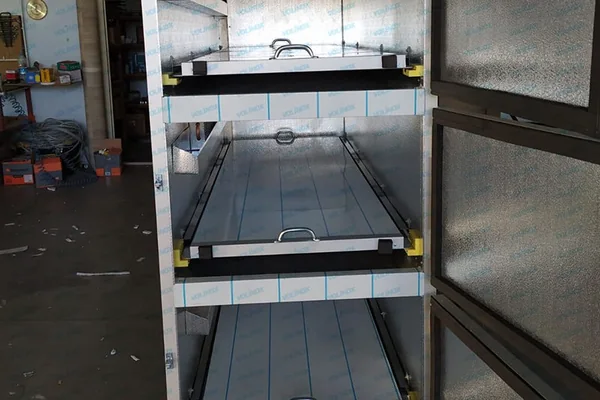
Cleaning a Mortuary Fridge: Stainless Steel Disinfection
A mortuary fridge is cleaned with detergent first and disinfected second. The steps, spillages and care rules that protect stainless steel.
Read more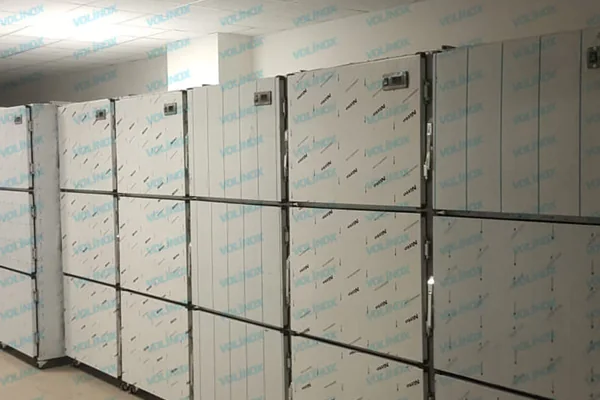
How Many Body Spaces Does a Hospital Mortuary Need?
A hospital mortuary's capacity comes from its records, not from bed numbers. The factors, a simple estimate, freezer share and space sizes.
Read more
What Is an Autopsy? How a Forensic Autopsy Is Carried Out
An autopsy is a medical examination of a body to find the cause of death. Who performs a forensic autopsy and what it covers, under the CMK.
Read more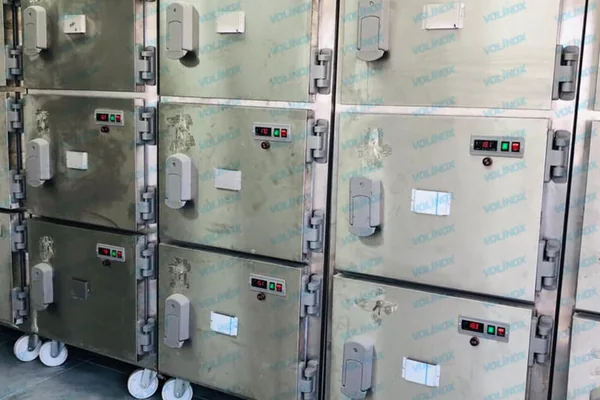
Morgue Refrigerator Temperature: Ranges, Monitoring and Alarms
Typical morgue refrigerator temperatures for short and long-term storage, and how to monitor, log and protect them with alarms and maintenance.
Read more