English
 Türkçe

24/7 Call Center


Mortuary capacity is the number of bodies a mortuary can hold with dignity at the same time, and in practice it comes down to one question: how many body spaces, or fridge compartments, does the facility need? There is no universal formula that multiplies the number of hospital beds by a fixed ratio. Health Building Note 16-01 (NHS England, 2023), the guidance used for hospital mortuaries in England, asks the mortuary manager and local partners to calculate capacity from all available evidence. This article summarises the factors in that guidance and a simple way to estimate the figure.
What determines mortuary capacity
The guidance asks planners to consider the following together:
- Clinical services: paediatric and maternity services, infectious diseases, trauma or transplant status all affect both the number and the size of spaces.
- Local demographics: the catchment population, its age profile and the proportion of people living with excess weight.
- Sites of particular risk: large industrial sites, entertainment and retail venues where mass casualty events could occur.
- Historic records: admissions, length-of-stay trends and exceptional periods in recent years.
- Any previous need for temporary storage.
How to estimate the number of spaces
The core of the calculation is to find average occupancy and then add a margin for busy periods. Average occupancy is roughly daily admissions multiplied by the average length of stay. For example, a hospital receiving about 1,100 bodies a year admits around three a day; if each stays three days on average, about nine spaces are occupied at any time. That is only an average, so the busiest weeks in the records need to be examined separately. The guidance expects permanent capacity to cover predictable peaks such as seasonal increases. The example only illustrates the method; real figures must come from the hospital's own records. Situations that lengthen the stay are covered in how long can a body stay in a morgue.
Refrigerated and freezer spaces
According to the guidance, bodies normally stay in the mortuary for one to four days, but this can extend to weeks or even months when next of kin are hard to trace or investigations take longer. Part of the capacity is therefore set aside as freezer space for long-term storage. The guidance specifies 4–6 °C for storage of less than 30 days and −20 °C for storage beyond 30 days, and the split between fridges and freezers follows length-of-stay trends. For temperature ranges in more detail, see morgue refrigerator temperature.
Space size is part of capacity
The width of each space matters as much as the count. The tray width ranges in the guidance are:
- Narrow (500–600 mm): only for paediatric storage and infill spaces.
- Standard (600–700 mm).
- Wide (700–800 mm): the guidance says this should be the predominant size.
- Bariatric (800–950 mm): for people living with excess weight.
The guidance also notes that each bay holds three to five tiers, and that the number of tiers depends on the room height and the equipment used to load and unload the trays. More tiers give more spaces on the same floor area, provided the handling equipment can reach that height. We cover this in mortuary lifting equipment.
A margin for exceptional periods
Building permanent capacity for every scenario is not economical. For periods of exceptional excess deaths, the guidance recommends setting aside space for temporary body stores in or near the mortuary, agreeing arrangements in advance with neighbouring mortuaries and funeral directors, and planning for temporary fridges. One such option is described in what is a container morgue.
Building capacity with Volinox morgue units
Volinox makes morgue units in single, double and triple pack-type versions; where more spaces are needed on the same floor area, the three-pack-type morgue unit is the natural choice. The stretcher size is 210 × 65 × 4 cm, and units can also be built to other dimensions. A size comparison of the models is given in mortuary cabinet types and sizes. To plan the number of spaces from your facility's records together, contact us through our contact page or on WhatsApp.
Note: the criteria are taken from HBN 16-01, the guidance used in England. For a healthcare building project in Türkiye, the Ministry of Health's current design standards and the facility's own data should be followed.
Share: WhatsApp
Frequently asked questions
How many body spaces does a hospital mortuary need?
There is no single fixed number. The count is calculated from the hospital's services, the local population, past admissions and length of stay, with a margin added for busy periods.
How is mortuary capacity calculated?
Average occupancy is roughly daily admissions multiplied by the average length of stay. The busiest weeks and seasonal increases in the records are then examined to set permanent capacity.
How many spaces should be freezers?
The share follows the facility's length-of-stay trends. HBN 16-01 in England specifies −20 °C freezers for storage beyond 30 days; freezer capacity matters more where legal processes take longer.
How wide should a mortuary fridge space be?
According to HBN 16-01, tray widths are narrow 500–600 mm (paediatric only), standard 600–700 mm, wide 700–800 mm and bariatric 800–950 mm, with wide spaces recommended as the predominant size.
Need a quote or technical details on this topic?Send us your size and capacity requirements and we will help you choose the right solution.
Related articles

What Is a Container Morgue? Temporary Storage in Disasters
A container morgue is a temporary body store inside a refrigerated container. Temperature, capacity, labelling and alternatives from the disaster manual.
Read more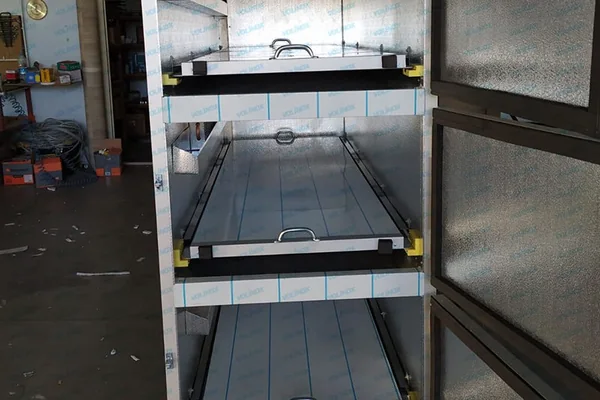
Cleaning a Mortuary Fridge: Stainless Steel Disinfection
A mortuary fridge is cleaned with detergent first and disinfected second. The steps, spillages and care rules that protect stainless steel.
Read more
What Is an Autopsy? How a Forensic Autopsy Is Carried Out
An autopsy is a medical examination of a body to find the cause of death. Who performs a forensic autopsy and what it covers, under the CMK.
Read more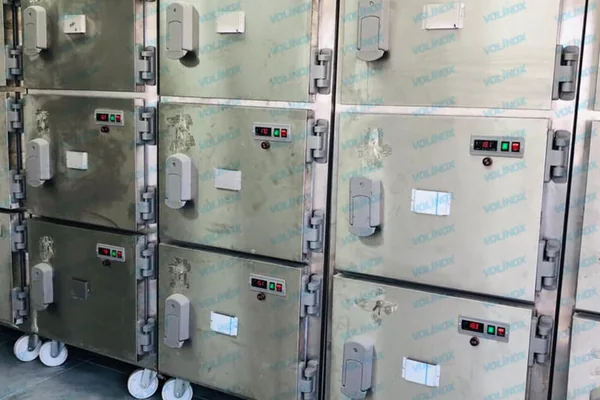
Morgue Refrigerator Temperature: Ranges, Monitoring and Alarms
Typical morgue refrigerator temperatures for short and long-term storage, and how to monitor, log and protect them with alarms and maintenance.
Read more