English
 Türkçe

24/7 Call Center

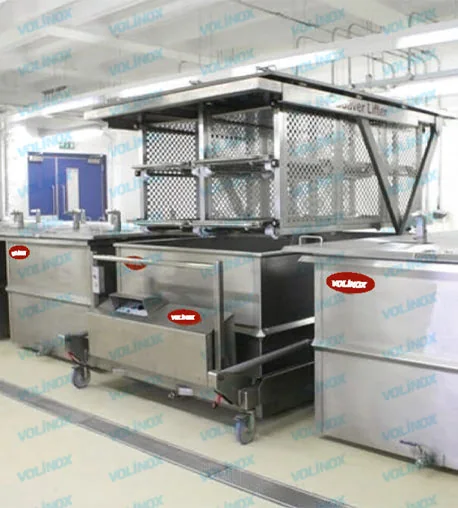
Much of the anatomy teaching in medicine, dentistry and the health sciences takes place on cadavers. Keeping these donated bodies preserved safely and respectfully over long periods is one of the core responsibilities of every anatomy department. A cadaver storage tank, sometimes called a cadaver immersion or preservation tank, is a stainless steel system in which embalmed cadavers are kept submerged in a preserving solution. This guide explains its components, how it works, what to look for when choosing one and how to use it safely.
How does a cadaver storage tank work?
An embalmed cadaver is placed on a transport tray or in a cage and lowered into the solution tank by the lifting system. When it is needed for teaching, it is raised with the same system, moved to the dissection table on a transfer trolley and returned to the tank afterwards. The main components listed on the Volinox product page are:
| Component | Purpose |
|---|---|
| Solution tank | Stainless steel vessel in which cadavers are kept in preserving solution |
| Cage lifter | Lowers the cadaver into and out of the tank without manual lifting |
| Transport trays | Allow the cadaver to move between tank, trolley and table on the same tray |
| Transfer trolley | Provides safe transport between the tank and the dissection table |
Volinox states that the system is designed for single-user operation and offers high storage capacity within compact dimensions. By keeping manual handling to a minimum, the lifting system protects both staff and the cadaver.
Selection criteria
- Capacity: decide the number of tanks, and the number of cadavers per tank, from your teaching programme and the number of donations you receive.
- Material compatibility: confirm at quotation stage that the tank, seals and valves are compatible with the solution you use.
- Lid seal: tight-fitting lids limit vapour release and stop the solution from evaporating.
- Lifting system: ask about lifting capacity, ease of control and an emergency stop.
- Ease of cleaning: smooth interior surfaces and rounded corners make it easier to clean the tank thoroughly whenever the solution is changed.
- Drainage: a controlled drain valve is needed for changing the solution and cleaning the tank.
- Floor loading: a tank full of solution is very heavy, so check the load capacity of the floor before installation.
Preserving solutions and formaldehyde safety
The composition of the preserving solution follows each institution's own anatomy and embalming protocol; mixtures containing formaldehyde, phenol, alcohol and glycerine are common examples. Formaldehyde vapour irritates the eyes and airways and is a recognised health hazard, so the laboratory should take the following precautions:
- Keep tank lids closed whenever the tank is not in use.
- Provide adequate general ventilation in the laboratory and local extraction around the tanks.
- Make sure staff wear suitable gloves, eye protection and liquid-proof aprons.
- Keep a spill kit and an eyewash station ready.
- Dispose of used solution as hazardous waste in line with local regulations.
- Have exposure levels assessed periodically by an occupational health and safety specialist.
Maintenance and records
- Check and record the level and condition of the solution at the intervals set in your protocol.
- Inspect lid seals, valves and the drain line regularly for leaks.
- Service the cage lifter and transfer trolley at the intervals the manufacturer recommends.
- Keep an up-to-date record of which tank and tray each cadaver occupies, matched to the donation records.
Laboratory layout
Placing the tanks close to the dissection room, on a route the transfer trolley can travel without obstruction, makes the workflow much smoother. Plan door widths around the trolley and tray dimensions, and choose a floor that is chemical-resistant, non-slip and easy to clean. Thinking about dissection tables and work surfaces such as an autopsy table as part of the same layout avoids unnecessary handling of the cadaver. For heavy transfers, hydraulic and mechanical lifts can also help.
Bodies that have not been embalmed are stored for short periods in a refrigerated morgue unit instead. Our morgue refrigerator temperature guide covers the ranges involved.
Related products and articles
You can see the system on our cadaver storage tank page and more equipment under hospital equipment. If you are also equipping a dissection or examination room, our autopsy table checklist may help. For a quote for your laboratory, contact us through our contact page or on WhatsApp.
Share: WhatsApp
Frequently asked questions
What solution is used in a cadaver tank?
The composition depends on the institution's anatomy and embalming protocol; mixtures containing formaldehyde, phenol, alcohol and glycerine are common. Confirm at quotation stage that the tank material and seals are compatible with the chosen solution.
Can one person operate a cadaver storage tank?
Volinox states that its system is designed for single-user operation. The cage lifter and transfer trolley minimise manual lifting, so one trained person can handle the cadaver safely.
How is a cadaver tank different from a morgue refrigerator?
A morgue refrigerator cools bodies awaiting burial or examination. A cadaver tank keeps embalmed bodies used for teaching immersed in preserving solution over long periods.
How often should the solution be changed?
That depends on the type of solution, how heavily the tank is used and the institution's protocol. Check the solution's condition regularly using the methods your protocol specifies, and keep records of every change and disposal.
Need a quote or technical details on this topic?Send us your size and capacity requirements and we will help you choose the right solution.
Related articles
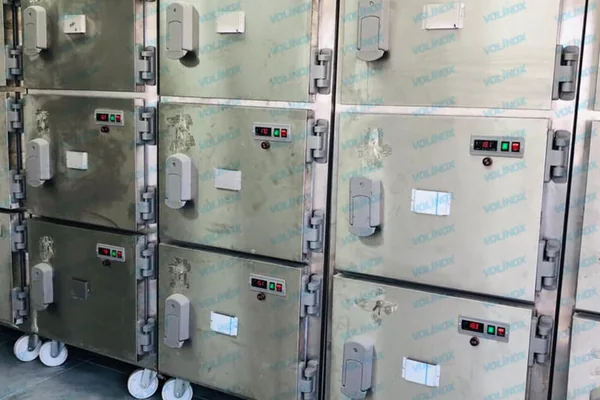
Morgue Refrigerator Temperature: Ranges, Monitoring and Alarms
Typical morgue refrigerator temperatures for short and long-term storage, and how to monitor, log and protect them with alarms and maintenance.
Read more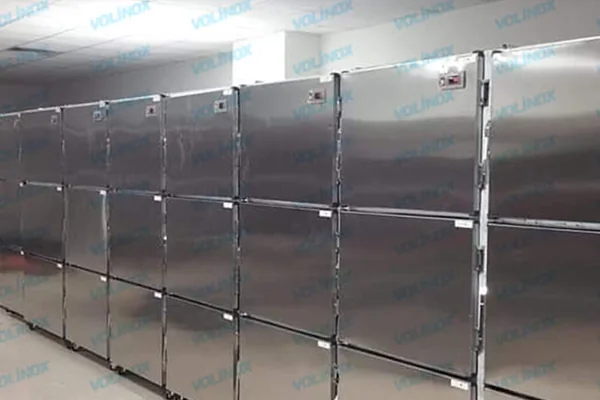
How Long Can a Body Stay in a Morgue? Short vs Long-Term
What determines how long a body stays in a morgue, when freezer storage is needed and how hospitals and municipalities can plan compartment capacity.
Read more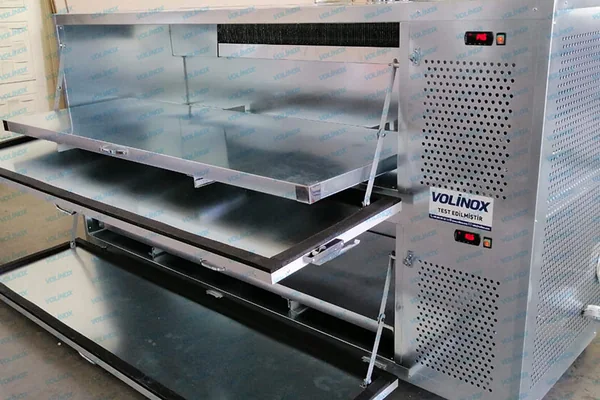
Mortuary Cabinet Types and Sizes: Choosing the Right Capacity
Compare single, two-tier, three-tier and washing-type mortuary cabinets by size and capacity, and see what to measure on site before you place an order.
Read more
Hearse Van Equipment Guide: Choosing a Funeral Transport Vehicle
A practical guide for municipalities and funeral services to hearse van interiors, refrigerated and standard options and a pre-purchase checklist.
Read more